Archive | August, 2020

House Finches: Loud and Brown and Red All Over

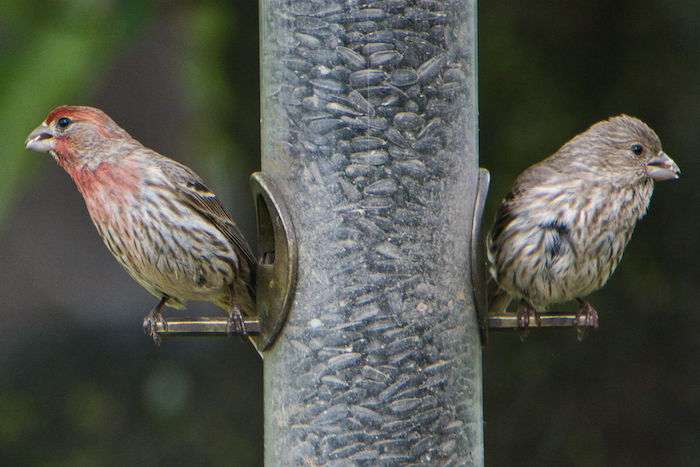
Male and Female House Finches

Male and Female House Finches at Feeder

If you have a bird feeder in the continental United States you have almost certainly been visited by house finches.  On both sides of the Mississippi their hungry flocks coat feeders like displays of cherry and root beer lollipops.  They park themselves at providential feeding ports or flutter at their neighbors to win better ones.  Off the feeders, they are singers who greet mornings with ubiquitous cheery notes, mixing reedy discord with melodious clarity, any time of year.  They seem perfectly comfortable making our houses their homes.

House finches fledge from the nest dressed in brown, heavily streaked on their undersides.  But as they molt, the males develop a bright red wash over their head, breast, and rump.  Young females, too, may briefly wear red on their rumps.  As adults, females prefer brightly colored males.
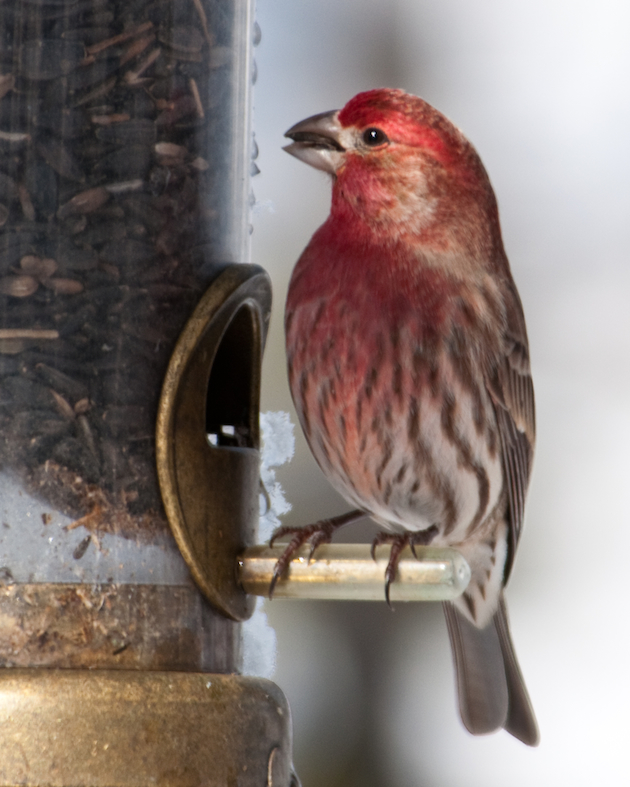
Male House Finch

Male House Finch

Bright colors, however, are not genetically inherited.  Like most birds, finches can’t actually make red or yellow pigment.  Rather, these molting males incorporate pigments from the foods they eat.  In addition to black oil sunflower seeds at feeders, they savor a variety of fruits and vegetables that contain the carotenoids–yellows, reds, and purples–that they absorb into feather-paint.
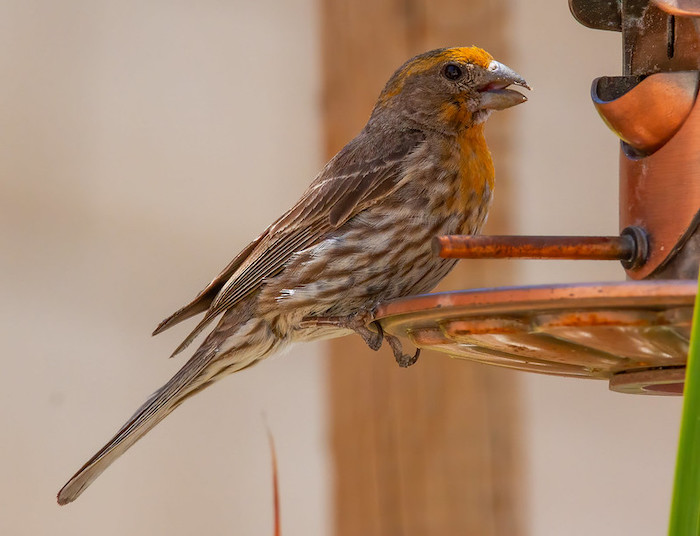
House Finch Male

House Finch Male courtesy Kevin Gill creative commons – Click on photo for full sized image!

Because their food varies geographically, male finches in some areas will wear, instead of red feathers, a more orange or even yellow hue.  Further, because the birds don’t migrate, you may be establishing a particular finch color in your neighborhood with your local blend of fruit trees, berries, and vegetable gardens.
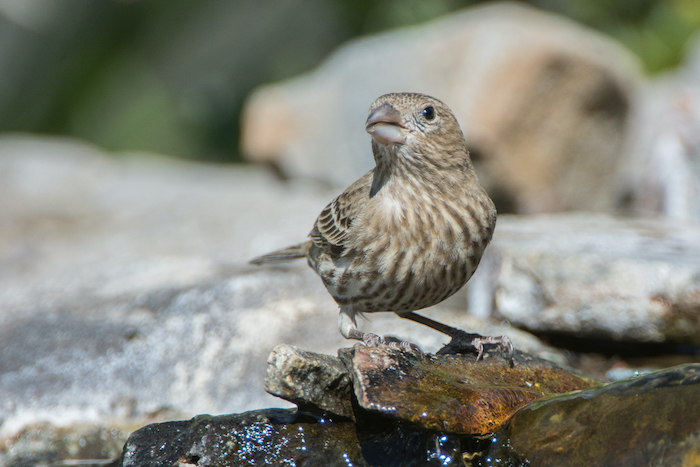
Female House Finch

The males, no matter their brightness, are famous for singing exuberantly near their mates while the female does the work of nest-building, laying eggs, and incubating them.  He may bring food to his mate during this period, and fully assists in tending their nestlings.  The system works for them: house finches lay 2-6 eggs in each clutch, and will clutch as many as six times a year.  With human help they have spread far and wide.
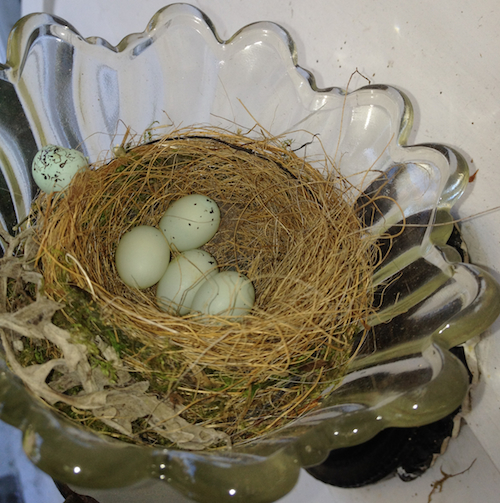
House Finch Nest with Eggs

House Finch Nest with Eggs

Native to the western US and Mexico, these desert-lovers were introduced to New York in 1940.  From there they expanded quickly throughout the east, substantially replacing the purple finch of the declining eastern forests.  Before conquering the east they were introduced into Oahu, and became abundant throughout Hawaii over a century ago.
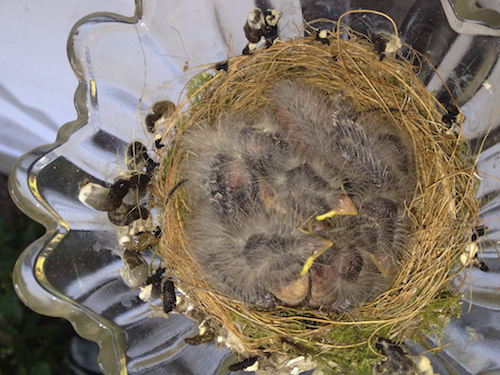
House Finch Nestlings

House Finch Nestlings

Hawaiian birds are famously fitted to particular plants or lifestyles, and have not done well as their world has changed.  House finches, on the other hand, are generalists, typical of birds that thrive in new situations.  They nest freely in not just their traditional western scrub and cacti but now in shrubs, trees, hanging plant-pots, on building ledges, or over porch lights.  They readily flock to feeders when their fields of seeds are transformed.  Strung wires serve for their singing posts.  House finches roll with the punches, and that has allowed them to prosper.
0

New Rules Defeather Birds – Again

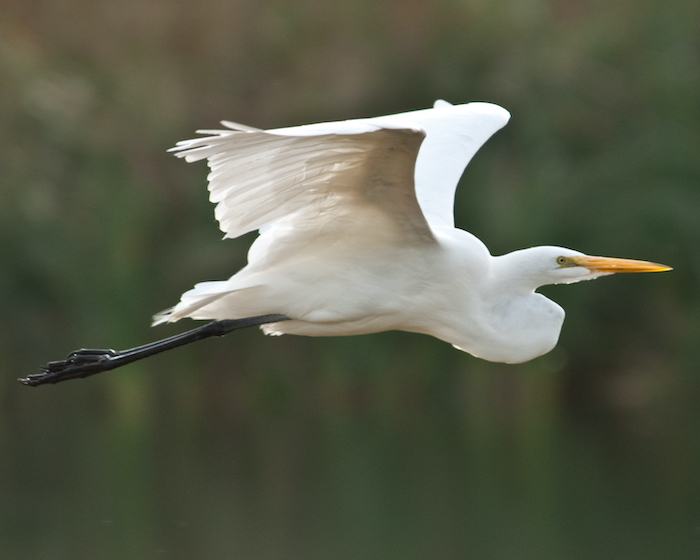
Great Egret in Flight

In 1896 egrets and other birds were being killed wholesale to use their feathers in women’s hats.  To protest and end the slaughter, Harriet Hemenway and Minna B. Hall formed a group, the original Massachusetts Audubon Society.  Within two years their movement had been replicated in fifteen other states and the District of Columbia.  Another five years, and the state organizations united into the National Audubon Society.

It was an era when modern industry was young and booming, and citizens were moving from family farms to jobs in the cities.  But like us, people valued the land and they recognized that its beauties and riches were not inexhaustible.  So they acted to protect those natural riches.  Women quickly abandoned feathered hats.  In 1903 our nation created the first National WIldlife Refuge, then the National Park Service in 1916, and in 1918, the Migratory Bird Treaty Act, or MBTA.

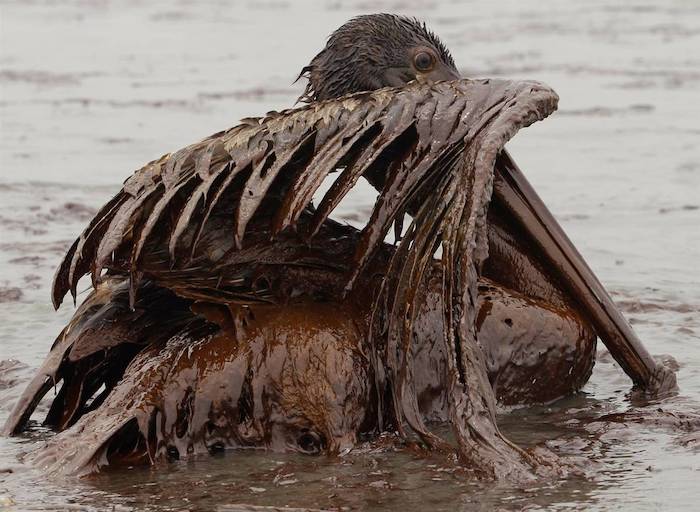
The MBTA put into US law what the country had already agreed to with Canada, and subsequently with Mexico, Japan, and the Soviet Union.  It prohibited the harming or “taking” of birds.  As clarified and amended over the last century, its provisions have promoted safety and efficiency.  After the Exxon Valdez killed 250,000 birds with a spill of enough oil to cover 34 acres a foot deep, the act supported fines and reparations of over $100 million, and Congress passed a requirement that oil tankers be double-hulled.  When BP’s Deep Horizon spilled two to fifteen times more oil, killing over a million birds, the company paid, to date, nearly $70 billion in cleanup, fines, and lawsuit settlements that have offset the losses to habitat, residents, and businesses.

Pelican in Deepwater Horizon Oil Spill

In the last two decades the act has been enforced with punitive damages only fourteen times, and for amounts that large businesses might shrug off.  Even BP’s Deep Horizon payouts of $70 billion were less than .2% penalties under the MBTA.  But that liability may have given teeth to the much larger public and commercial lawsuits for recovery from losses.  

The act provides for waivers for various purposes including education, research, and safety.  It protects only native species, and provides for game bird hunting seasons.  It is hailed as our nation’s best legislation to protect birds.  

But two years ago the Trump Administration gutted it.  It reinterpreted the law to allow incidental take, with no waivers required and no penalties levied.  “Incidental” takes are killings that happen as a by-product of actions.  The new interpretation eliminates fines for misapplying pesticides that kill hundreds or thousands of birds on a single mega-farm, or for poor maintenance on an oil rig that kills a million birds or more.  Every incentive to consider the well-being of birds is removed by this interpretation.  Routine practices that save millions every year–covering oil waste pits, spacing power lines to avoid electrocution, replacing tower lights with blinking ones–are rendered valueless.  This ruling replaces the public wealth of nature’s beauty and richness with a narrower, purely monetary value.

It has become common knowledge that birds are already in a precipitous decline.  Some species like the desert-adapted ash-throated flycatcher are doing well, but overall there is a 30% loss of North American birds over the last fifty years

Now the Administration is trying to make the interpretation that removes bird protections into permanent law.  Our representative in Congress has repeatedly stated his commitment to outdoor access, but the outdoors that we can access are being impoverished.  He calls efforts to protect wildlife and clean habitats “government overreach,” but given the decline of our birds it appears to be under-reach.  

Now there is a bill in Congress to protect the MBTA from being demolished.  Representative LaMalfa can sign on as a cosponsor to the Migratory Bird Protection Act, H.R. 5552.  He can work publicly and vigorously with the Administration, his party, to get the bill enacted into law.  If you, like Harriet Hemenway and Minna Hall of yore, want to weigh in, Rep. LaMalfa can be reached through his form at https://lamalfa.house.gov/contact or the Redding office (530) 223-5898.

The egrets won’t thank you.  But they might survive.

0