Author Archive | Dan Greaney

New Rules Defeather Birds – Again

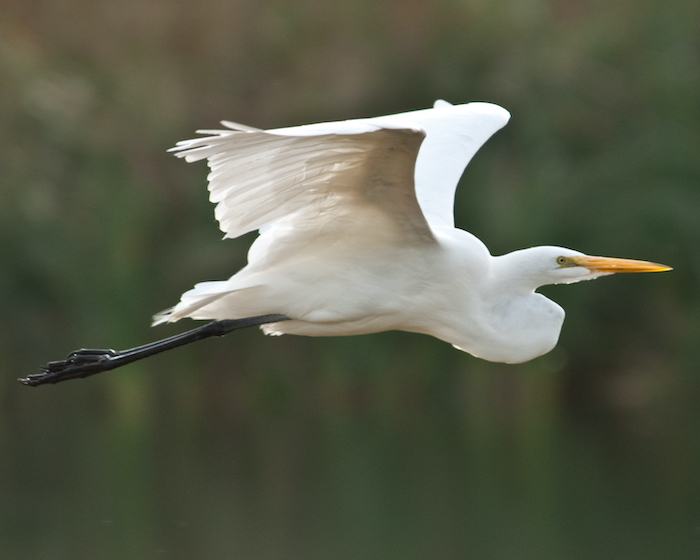
Great Egret in Flight

In 1896 egrets and other birds were being killed wholesale to use their feathers in women’s hats.  To protest and end the slaughter, Harriet Hemenway and Minna B. Hall formed a group, the original Massachusetts Audubon Society.  Within two years their movement had been replicated in fifteen other states and the District of Columbia.  Another five years, and the state organizations united into the National Audubon Society.

It was an era when modern industry was young and booming, and citizens were moving from family farms to jobs in the cities.  But like us, people valued the land and they recognized that its beauties and riches were not inexhaustible.  So they acted to protect those natural riches.  Women quickly abandoned feathered hats.  In 1903 our nation created the first National WIldlife Refuge, then the National Park Service in 1916, and in 1918, the Migratory Bird Treaty Act, or MBTA.

The MBTA put into US law what the country had already agreed to with Canada, and subsequently with Mexico, Japan, and the Soviet Union.  It prohibited the harming or “taking” of birds.  As clarified and amended over the last century, its provisions have promoted safety and efficiency.  After the Exxon Valdez killed 250,000 birds with a spill of enough oil to cover 34 acres a foot deep, the act supported fines and reparations of over $100 million, and Congress passed a requirement that oil tankers be double-hulled.  When BP’s Deep Horizon spilled two to fifteen times more oil, killing over a million birds, the company paid, to date, nearly $70 billion in cleanup, fines, and lawsuit settlements that have offset the losses to habitat, residents, and businesses.
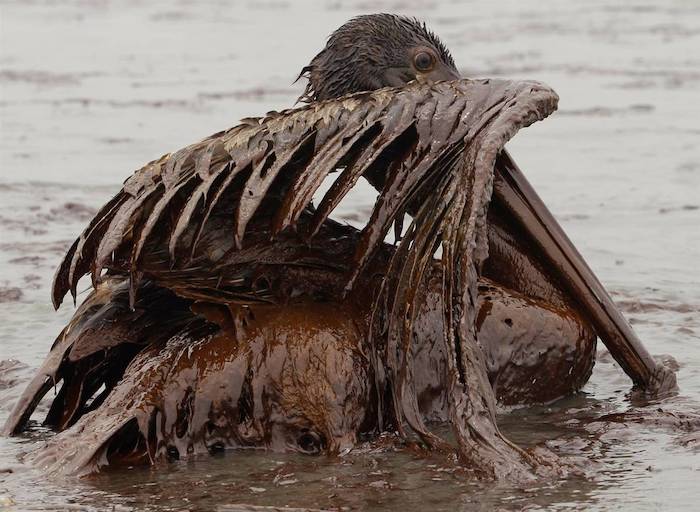
Pelican in Deepwater Horizon Oil Spill

In the last two decades the act has been enforced with punitive damages only fourteen times, and for amounts that large businesses might shrug off.  Even BP’s Deep Horizon payouts of $70 billion were less than .2% penalties under the MBTA.  But that liability may have given teeth to the much larger public and commercial lawsuits for recovery from losses.  

The act provides for waivers for various purposes including education, research, and safety.  It protects only native species, and provides for game bird hunting seasons.  It is hailed as our nation’s best legislation to protect birds.  

But two years ago the Trump Administration gutted it.  It reinterpreted the law to allow incidental take, with no waivers required and no penalties levied.  “Incidental” takes are killings that happen as a by-product of actions.  The new interpretation eliminates fines for misapplying pesticides that kill hundreds or thousands of birds on a single mega-farm, or for poor maintenance on an oil rig that kills a million birds or more.  Every incentive to consider the well-being of birds is removed by this interpretation.  Routine practices that save millions every year–covering oil waste pits, spacing power lines to avoid electrocution, replacing tower lights with blinking ones–are rendered valueless.  This ruling replaces the public wealth of nature’s beauty and richness with a narrower, purely monetary value.

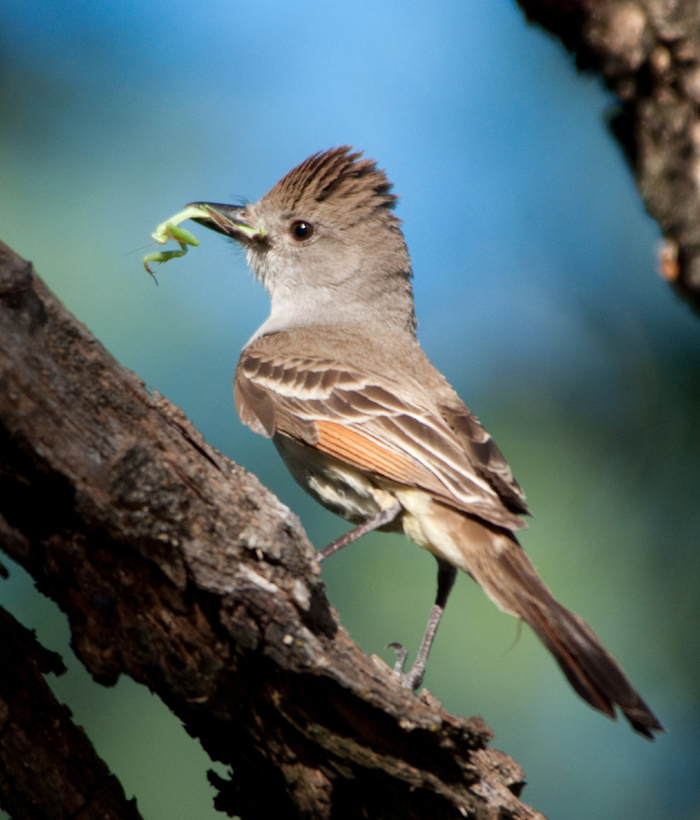
It has become common knowledge that birds are already in a precipitous decline.  Some species like the desert-adapted ash-throated flycatcher are doing well, but overall there is a 30% loss of North American birds over the last fifty years

Now the Administration is trying to make the interpretation that removes bird protections into permanent law.  Our representative in Congress has repeatedly stated his commitment to outdoor access, but the outdoors that we can access are being impoverished.  He calls efforts to protect wildlife and clean habitats “government overreach,” but given the decline of our birds it appears to be under-reach.  

Now there is a bill in Congress to protect the MBTA from being demolished.  Representative LaMalfa can sign on as a cosponsor to the Migratory Bird Protection Act, H.R. 5552.  He can work publicly and vigorously with the Administration, his party, to get the bill enacted into law.  If you, like Harriet Hemenway and Minna Hall of yore, want to weigh in, Rep. LaMalfa can be reached through his form at https://lamalfa.house.gov/contact or the Redding office (530) 223-5898.

The egrets won’t thank you.  But they might survive.
0

Ash-throated Flycatcher, a Bird for our Time

Ash-throated Flycatcher

Ash-throated Flycatcher with Praying Mantis

G-r-rick!  G-r-rick!  The woodland call of the ash-throated flycatcher manages to sound both dry and optimistic, and this bird has reason to feel both.  It is well adapted to the summer conditions of the arid west.

Although it sports a hipster beanie and jaunty colors–a sulphur-yellow belly, burnt orange in the wing, and a red-brown tail–you are apt to hear the bird before you see it.  From a perch or in flight, its frequent calls abound in our north state woods.

These birds are up from coastal Mexico, reversing the summer vacation travels of many pre-Covid Americans.  But of course they are here not to vacation but to raise their families on the abundant insects of the season.  Unlike many kinds of flycatchers, they rarely capture their meals out of the air.  Rather they perch in the understory, study the foliage and bark near them, and then hover to pick their insect prey from the plant.

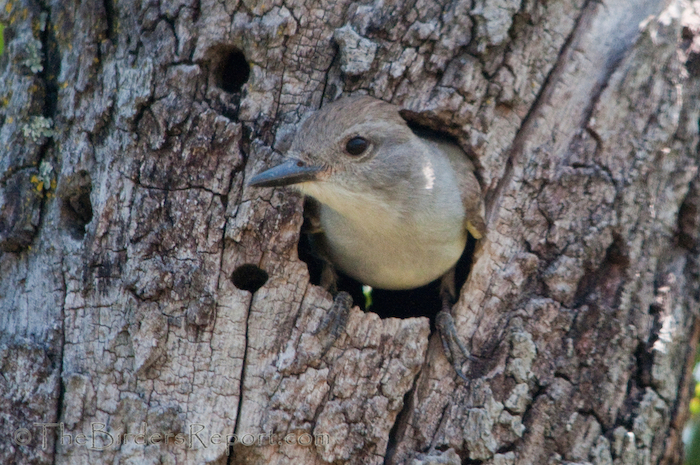
Ash-throated Flycatcher at Natural Cavity

Ash-throated Flycatcher at Natural Cavity

Gleaning insects is a service that should not go unrewarded, and trees, particularly oaks, generously provide cavities that the birds use as nest sites.  Along with oak-rot hollows, ash-throated flycatchers readily nest in cacti cavities, woodpecker holes, nesting boxes, drain pipes, or the deep pocket of a jacket left hanging over the back fence.

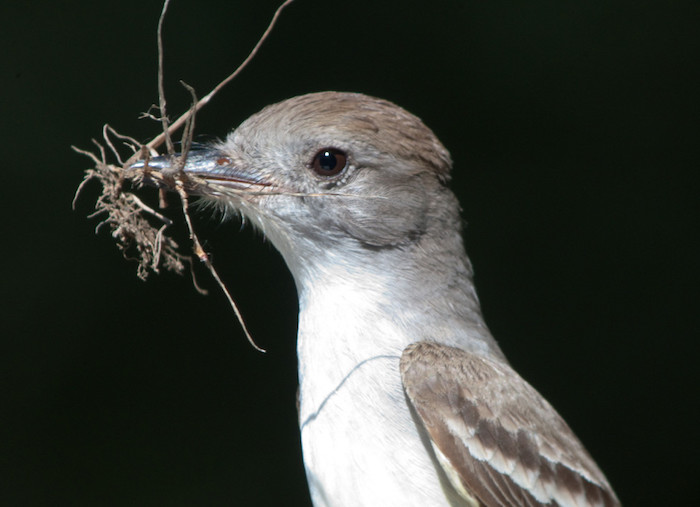
Ash-throated Flycatcher

Ash-throated Flycatcher with Nesting Material

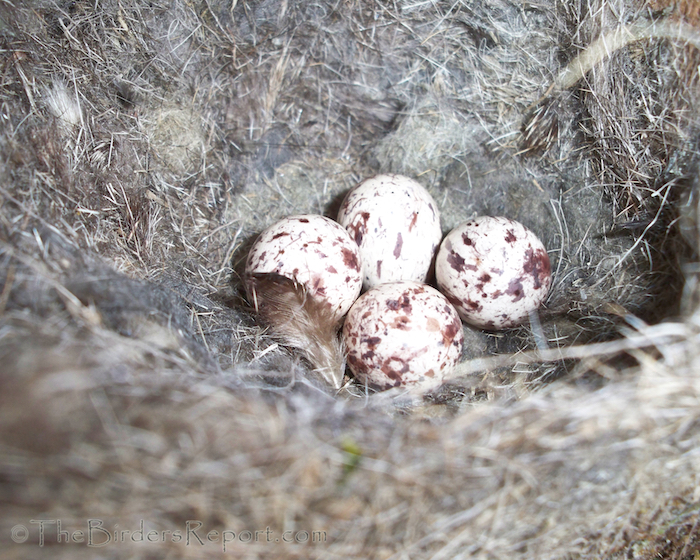
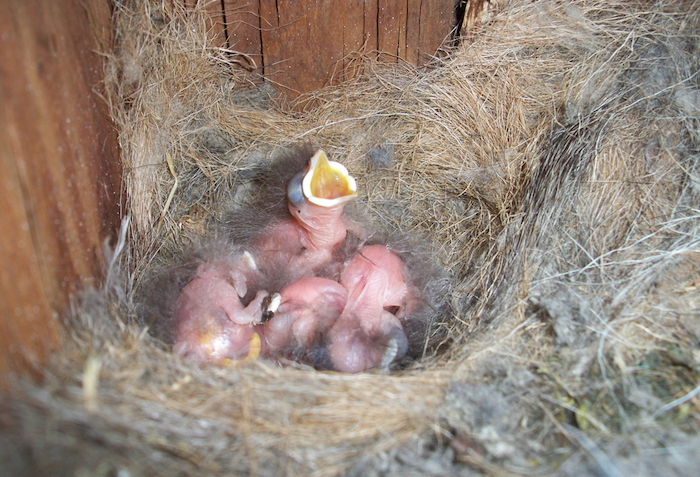
Both parents build the nest of various plant fibers.  The mother bird incubates her handful of eggs for two weeks, and both parents feed the young about sixteen days more, as their offspring grow from naked to feathered to feeding themselves.  Though just the size of grocery-story zucchinis, they develop the mesomorphic form of strong flyers–big-breasted due to powerful flight muscles.

Ash-throated Flycatcher Eggs

Ash-throated Flycatcher Eggs

Beginning as soon as July and lasting into early fall, those muscles will propel the birds on a fifteen-hundred mile migration.  The North State insect populations wane, and the flycatchers head for buggier turf to power their next month-long phase of life–shedding their worn feathers and growing new ones.

Ash-throated Flycatcher Nestlings

Ash-throated Flycatcher Nestlings

Several qualities feed the optimism that ash-throated flycatchers warrant.  Their ready adoption of human artifacts for nesting sites serves them well.  Also, they usually line their nests with mammal fur, which is soft for the nestlings but less insulating than feathers and so may reduce overheating that feathers could cause as the seasons warm.  Further, ash-throated flycatchers do not need to drink water; like some other desert dwellers, they manufacture enough for themselves in the process of digesting their food. In this warming arc of the world, ash-throated flycatcher populations have grown about 1% per year over the last fifty years.

0

The Bird Escape

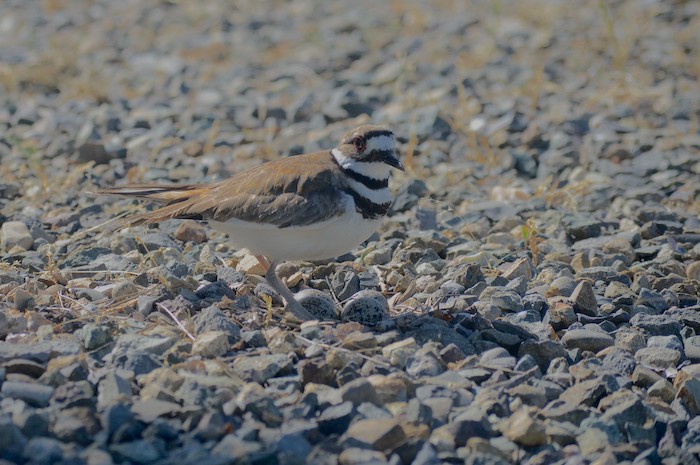
Killdeer on Eggs

Killdeer on Eggs

Sometimes the garden is not quite right. Coronavirus and the other horsemen are trampling the flowers, and the misshapen economy will make next year’s seeds a stingier find. And even then, you may not be able to grow much because of climate change. Is there any help beyond Netflix and sedation?

Yes: bird-watching. It’s accessible, versatile, and beautiful. And a whole lot healthier than couch-bingeing.

But how do you start? Local Audubon activities are shut down, but the website, wintuaudubon.org, remains a rich resource. I’ll highlight a few and put them in context.

First, where can you watch birds? Since you’re at home, that can be an excellent place. If there are trees and shrubs around, then you are apt to find a variety of birds. You can put out feeders to attract them into a handy viewing area. For information on feeders and seed, click on the website’s “Attracting Birds” under the “Places to Bird” tab. For your own good viewing, or if you have children under, say nine, who can’t yet handle binoculars, then consider putting the feeders up close to a window. Window collisions are killers, but if feeders are placed within three feet of the window then slower flight speeds around the feeder make harmful collisions rare.

Of course, don’t expect the birds to be tidy. And recognize that, depending on your local traffic, it may take birds some weeks to find your feeders. But then the word will spread.

If you’re able to get outside, birding can enrich your walk. Here in the North State we have numerous parks and trails that support both wildlife viewing and physical distancing. Turtle Bay, Mary Lake, Clover Creek, and the Sacramento River Trail are among the in-town birding hotspots. Again, see the “Places to Bird” tab for more information.

You’ll need a pair of binoculars. Without them you will not see the rich colors of the birds. Fortunately, optics have improved in recent years, and excellent binoculars are available at reasonable prices–sometimes better prices than the reviews indicate. I recommend starting with the “How to Choose Your Binoculars” article under the “Get Outside/Binocular Guide” tab at audubon.org. It gives a straight scoop on quality, usefulness, and price. Then read reviews and shop.

At home or on a walk, it’s nice to be able to know what you are seeing. Scroll down the right column of the Wintu Audubon home page to find the Shasta County Bird Checklist. This printable list shows the seasonal abundance of our birds. For another useful resource, you may want to download the Merlin app, which uses the date, your location, and your answers to just a few questions to identify the bird.

Of course, bird watching is more than bird identification. Close observation can reveal what a bird eats, how it gathers its food, whether it has a nest nearby, how it is taking care of itself, or how it gets along with its neighbors. The website allaboutbirds.org can feed your understanding with species by species information about the birds.

Wintu Audubon hopes to be running programs and bird walks again this fall. In the meantime, binoculars, a field guide or online app like Merlin, perhaps a feeder, and some time let us see a world that is at least as real as the one sinking us into the couch.

0

Bright Spots in Northern California

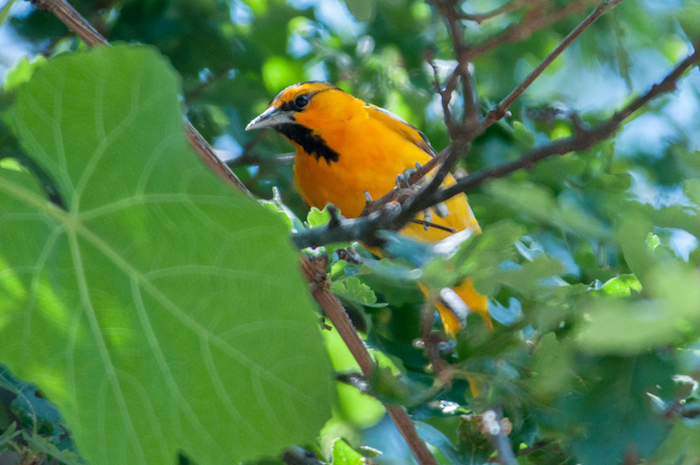
Bullock's Oriole Male

Bullock’s Oriole Male

Nature with its feathers and its viruses does not dance for our pleasure or pain.  Water does not need us to make a river. But we, of course, can both minimize natural suffering and enjoy natural beauties.

There are uncounted bright spots freshly arrived in northern California.  Spring blooms deck our yards and fields, and, in the bird world, subtropical migrants have returned, decked in their finest plumage.

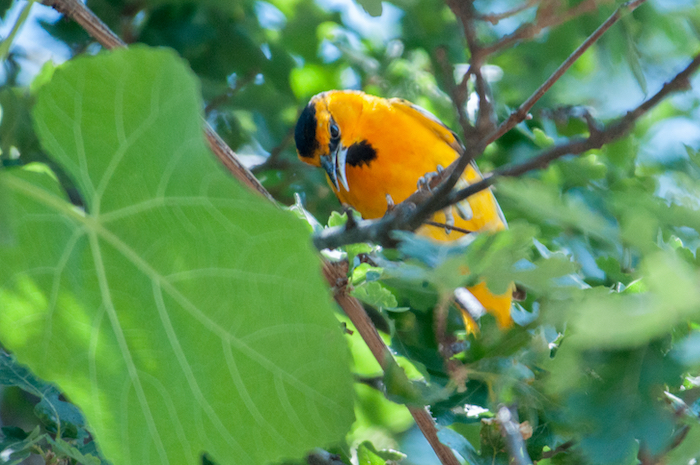
Bullock's Oriole Male

Bullock’s Oriole Male

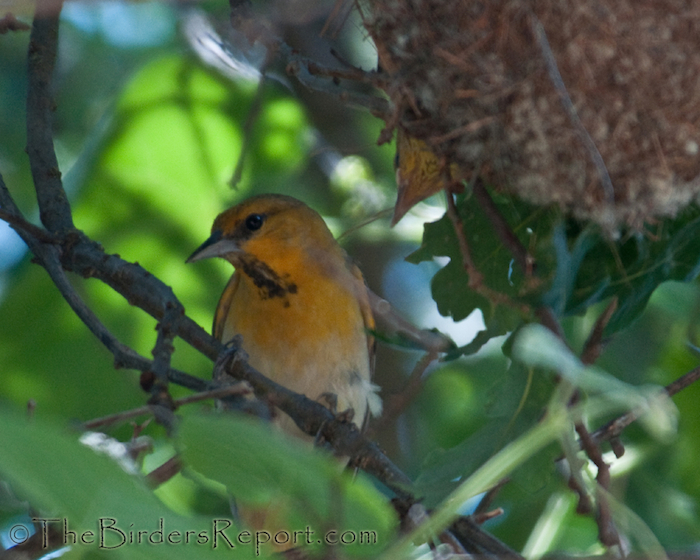
Among the brightest are orioles.  Bullock’s oriole males sport brilliant orange breasts and faces; their topside is mainly black, including an onyx cap, eyeline, and chin, with contrasting bright white patches on their wings.  Females are yellow breasted, fading to a whitish belly; their backs are pale brown–the pale colors that help hide them and their nests, and so keep the species going.

Bullock's Oriole Female

Bullock’s Oriole Female at the Nest

And these beauties dance.  When I was six years old I was given a package of plastic animals, each about my pinky-length.  The mammals were cast in brown, the birds in blue. In less than a day I lost my instant favorite, the wily weasel.  Gradually I lost the others, roughly in order of how much I valued and therefore played with them. The last to go was a clunky blue thing identified as an oriole.

It did the orioles injustice.  They are not clunky. The uniform blue I could allow; it was the color of the plastic, and I knew nothing different.  But its statue-stiff stance belied the birds’ reality. More accurately, the Cornell Lab of Ornithology opens its description of these orioles with the word “nimble.”

Orioles are nimble in so many ways.  Our Bullock’s orioles dangle from the swaying tips of cottonwood and valley oak branches and weave there the hanging baskets that will hold their eggs and nestlings.  They glean insect meals from those same precarious twigs–or from larger branches, or trunks, or from spider webs, or brush on the ground. They are versatile, and also resourceful.  If they catch a bee, they’ll pull and discard the stinger before dining. If they catch a toxic butterfly, such as a monarch or pipevine swallowtail, they’ll bang it on a branch to extract just the insides and avoid the poisons stored in the butterfly’s skin.  Or they’ll eat fruit, creating juice by piercing the skin and opening their bills inside, and then lapping the mushy liquid with their long tongues. Or they’ll use those tongues at hummingbird feeders, where a modest perch and a broken-out floret can invite repeat visits.

Their flexibility extends even to their human association and naming.  For a while Bullock’s orioles had been lumped into a single species with Baltimore orioles; the two do hybridize where their ranges meet in the Great Plains.  Further studies, however, have separated them back into the two species that their different color patterns had originally suggested.

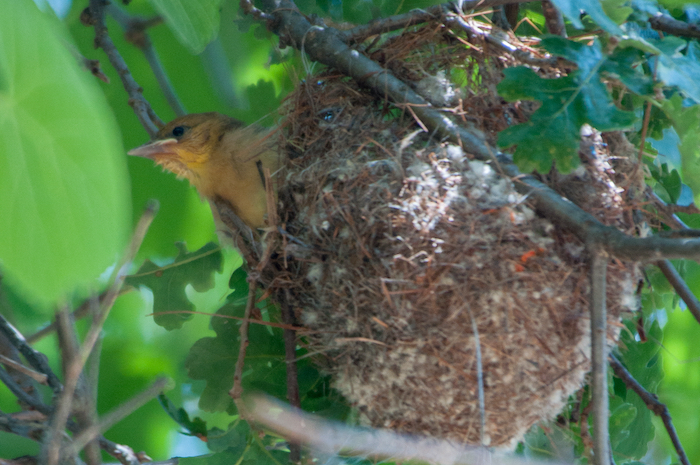
Besides being brilliant and nimble, these birds are fast.  To see them, listen for their harsh chatter mixed with melodious squeaking, and keep an eye to your taller trees.  Perhaps you will find one of their twig-end nests, a hanging basket the size of a big orange. After two weeks of incubation, both parents will tend the nestlings there, offering ready views of some of nature’s brightest beauties.

Bullock's Oriole Nestling

Bullock’s Oriole Nestling

0

Numbers

Snow Goose Flock

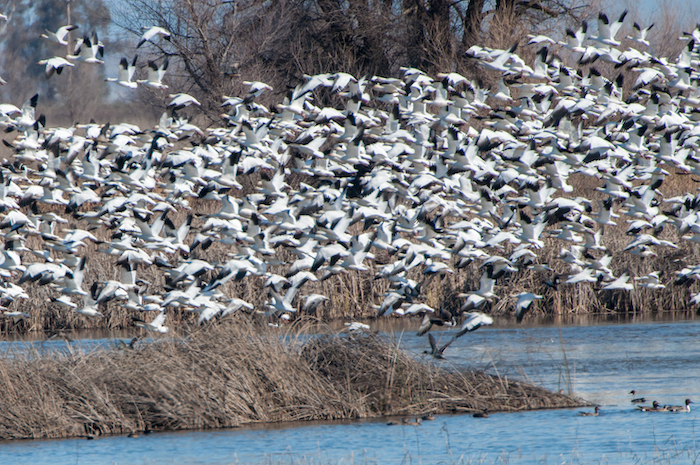
Snow Goose Flock Taking Off at Sacramento National Wildlife Refuge

How many feathers are on a swan?  How many miles does a black swift fly in a year?  How many breaths does a hummingbird take in ten seconds?  Numbers can tell fascinating stories. Unfortunately, they can also become a blur that fails to have meaning.

As a teacher, some years back I was exposed to the idea of innumeracy, the math equivalent of illiteracy.  We know that habits of both thoughtful reading and number evaluation expand our scope of competence as citizens and consumers.

American Robin

American Robin

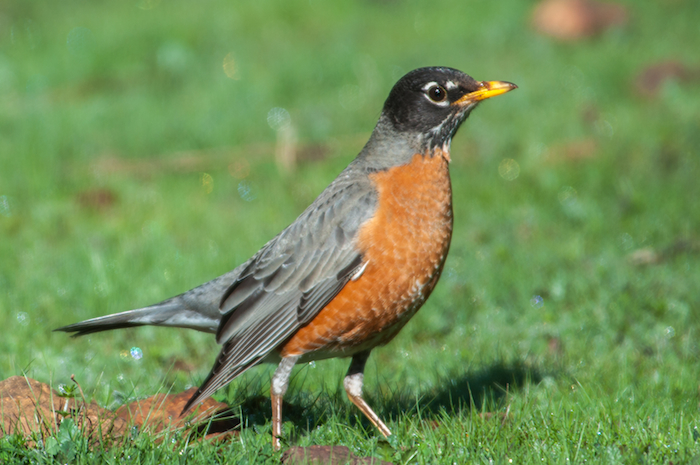
Birds, however, show only rudimentary math abilities.  In one study, researchers let robins watch as they dropped two worms into a box, but they rigged the box with an upper layer holding only one worm.  The robins subsequently went to the box and, on finding only one worm where they saw two dropped, pecked at the box long and hard in apparent frustration.  When the researchers allowed access to both worms, the birds gobbled the two and quickly moved on.

Other studies indicate that parrots can count up to six, and crows to eight.  Cormorants used by fishermen on the Li River in China are normally allowed to eat every eighth fish they catch, and have been observed after catching seven fish refusing to dive until their neck ring is loosened–a sort of minimum-wage strike among the birds.

Pigeons have learned to peck at groups of objects in order of the number of objects in them.  Interestingly, having learned to peck in order 1, 2, 3, they can continue with numbers beyond their training, pecking in order groups of up to eight, clearly showing some arithmetic sense.  Above eight, well, researchers have not boldly gone into the uncharted territory of nine and beyond.

Of course, mathematical sense probably has limited use for most birds.  Mostly bird intelligence trends toward other skills such as long-distance navigation, nest-weaving, and music.

For us, math has more varied meanings: finding the best buy with grocery store arithmetic, understanding interest rates for both investments and loans, calculating income and cost of living.  In business and government, arithmetic shows potential profits and losses, and allows planning for pandemics, climate change, and the quantity of waste products of our still-growing human population.  Understanding these numbers can help us design efforts to treat one another humanely and leave a beautiful world behind us.

Regarding birds, I used to use ballpark figures: ten billion birds in winter in North America, twenty billion in spring right after the nesting season.  But now the winter number is cut to 7 billion, a 30% decline in my lifetime. These numbers are echoed and exceeded in studies of fisheries and insects. They are numbers that, for moral, esthetic, and practical reasons we should not ignore.  They speak of degrading habitats worldwide that increasingly cannot support a full array of wildlife or human life. How many more millions of acres are becoming unfarmable? How many nations are becoming unable to feed themselves, and so feeding only their wealthy and their thugs, turning how many more people into refugees and extremists?

Right now we are immersed in dealing with a coronavirus, whose numbers are potentially brutal.  Beyond that priority we must look ahead to climate change, whose numbers are yet more disastrous and longer-term.  We form and manage those numbers through our lifestyles, our purchases, our votes, our literacy and our numeracy. They are numbers that can guide us well or can undercut both our direct prosperity and our world’s wealth of swan feathers, black swift miles, and hummingbird breaths.  The numbers are important.

0