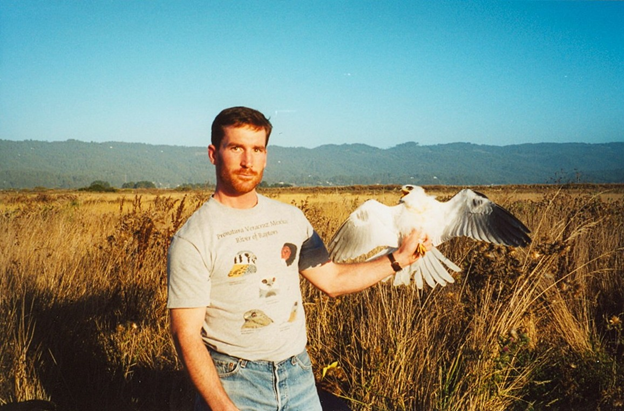
With practice and experience, one can quickly separate different groups of raptors based on flight style, gestalt and plumage characteristics. Learn some tips and tricks about raptor identification on the wing, raptors at a distance and some local raptor viewing spots to practice your skills.
Russ Namitz was born and raised in Lincoln City, Oregon. At age 9, he was captivated by the furtive Pacific Northwest denizen of dank woods, the Varied Thrush. With a few stepping stones along the way, Russ really began actively birding the summer after graduating from Pacific University in Forest Grove, OR. His first, of many seasonal biology field jobs to follow, was searching for nesting Northern Goshawks in the Okanogan NF in Washington. In 2002, Russ finally took an Ornithology class, coincidentally from Humboldt State University. He enjoyed a year of birding in the area, meeting local celebrities and rubbing elbows with the talented birders and riff raff (sometimes the same people) in the area. Russ is a pelagic bird guide for Oregon Pelagic Tours and currently holds the Oregon Big Year record of 381 species.
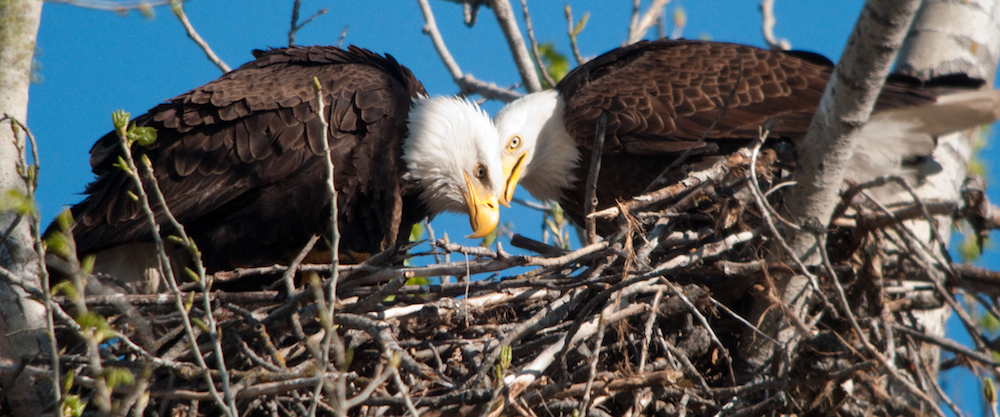
Terri Lhuillier will share the continuing saga of our famous Redding Eagles as she begins her 17th Nesting Season closely monitoring the local bald eagle pair. Terri has been following “Liberty” for 17 years since the bald eagle pair first arrived & built a nest at Turtle Bay in Redding back in 2004. She has spent numerous hours observing, documenting & photographing Liberty with her 3 mates as they successfully raised 22 eaglets from egg to fledgling!
Terri will discuss how her passion for eagles has grown over the years and how now, she and her husband Dave, monitor seventeen bald eagle nests in Redding, Anderson, Palo Cedro, Red Bluff and Corning. Terri and Dave document annual nesting data for the nests which they share with several Fish and Wildlife and Whiskeytown biologists to help them monitor the local bald Eagle population.
Wintu Audubon Society is inviting you to a scheduled Zoom meeting.
Topic: As The Nest Turns: The Continuing Saga of the Redding Eagles
Time: Jan 13, 2021 07:00 PM Pacific Time (US and Canada)
Meeting ID: 915 0064 4744
One tap mobile
+16699006833,,91500644744# US (San Jose)
+12532158782,,91500644744# US (Tacoma)
Dial by your location
+1 669 900 6833 US (San Jose)
+1 253 215 8782 US (Tacoma)
+1 346 248 7799 US (Houston)
+1 312 626 6799 US (Chicago)
+1 929 205 6099 US (New York)
+1 301 715 8592 US (Washington D.C)
Meeting ID: 915 0064 4744
Find your local number: https://zoom.us/u/acIVevKNJH
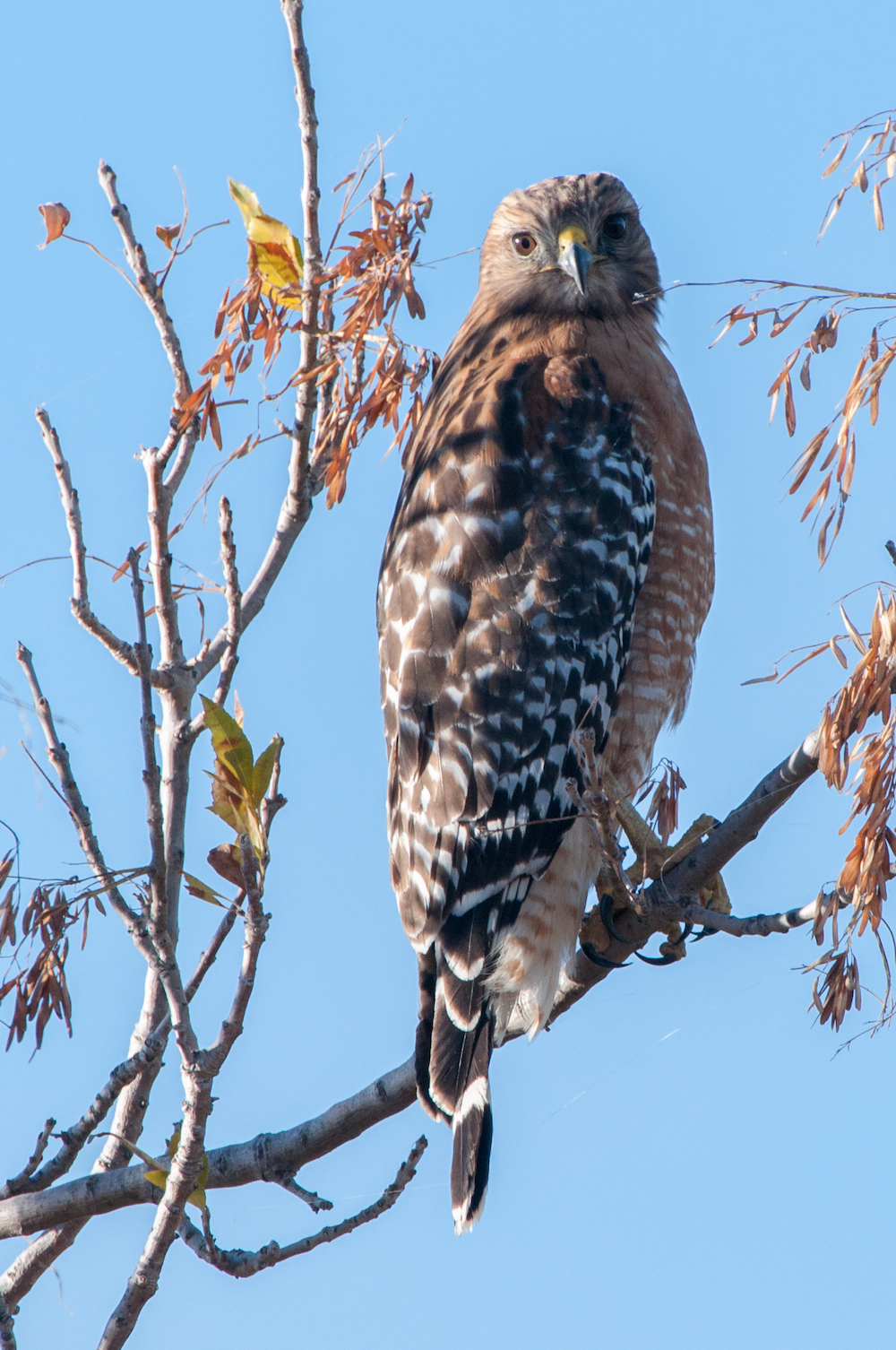
Bob Yutzy will present a visual guide with commentary covering the main identification features of our local Hawks. Photos will be used to show the various plumages and phases of these magnificent flying machines.
Bob is the North American Birds sub-regional editor and eBird Reviewer for Shasta County, and our local County Checklist Chairperson. He and his wife Carol are compilers of the Fall River Mills CBC, and have been completing hawk count and breeding bird routes in Southeast Arizona and California for over 30 years.
Meeting ID: 892 0083 5402
One tap mobile
+16699009128,,89200835402# US (San Jose)
+12532158782,,89200835402# US (Tacoma)
Dial by your location
+1 669 900 9128 US (San Jose)
+1 253 215 8782 US (Tacoma)
+1 346 248 7799 US (Houston)
+1 312 626 6799 US (Chicago)
+1 646 558 8656 US (New York)
+1 301 715 8592 US (Germantown)
Meeting ID: 892 0083 5402
Find your local number: https://us02web.zoom.us/u/kEaSJYIOD
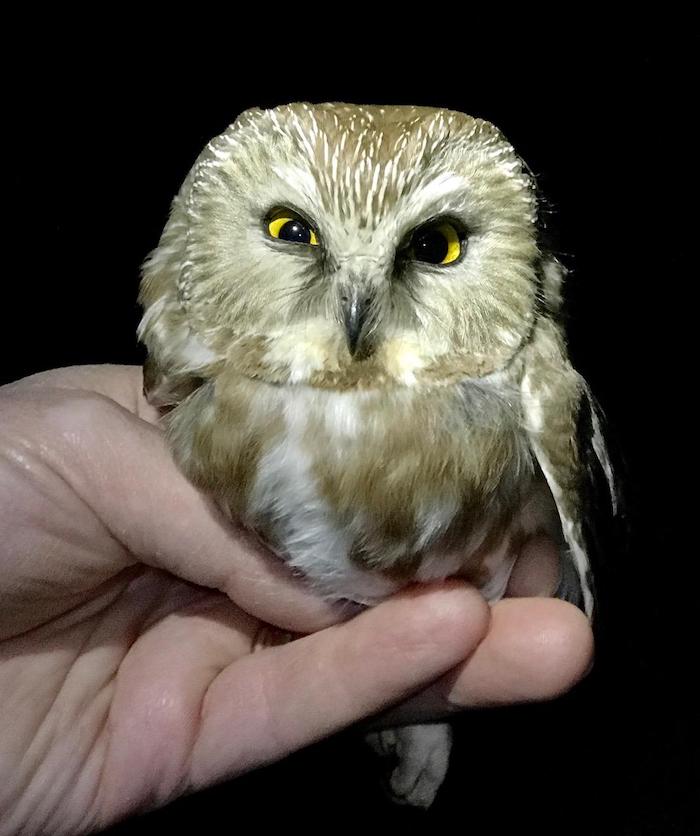
We all have our blind spots, but when the spots are small and secretive we might be forgiven them. At Wintu Audubon’s general meeting last month, Ken Sobon, director of the Northern Saw-whet Owl Project, introduced attendees to a much overlooked little predator that could well be the most numerous owl in North America.
It’s not exactly invisible, but even avid bird watchers are unlikely to have seen this puffball. Daytimes it hides away, roosting quietly in thick foliage, remaining still even as you pass right by. At night you might hear it, especially if you get out into our local coniferous forests. This time of year males begin their long-running nocturnal too-too-too calls, which can beckon a female from half a mile or more away. If interested, she carols back with her own songs–high squeaks or a rising wail that is music to his ears. He may then sing and circle her many times before alighting at her side.
The male often shows her a cavity that he thinks will make a good nest–perhaps a hole carved in a snag by a large woodpecker, with a nearby meadow for hunting. Of course, she seems to make the final decision on just where she will lay her half-dozen eggs. That nest will be her station for the roughly forty-five days of incubation and early child care.
Like raptors around the world, she begins incubating as soon as the first egg is laid, so her young hatch not all at once, as chickens do, but over a period of a week or more. If food is plentiful, all the young may survive; the male may even support two mates and two nests. If food is scarce, however, only the older siblings are apt to successfully fledge.
He hunts every night. From a low perch in the quiet of the forest, he listens for the rustling of small rodents, and then swoops down. He kills with the piercing clutch of his talons. He is scarcely the size of a man’s fist, and the mice and voles he captures can easily weigh half as much as he does. But he ferries the load to the nest where, if the eggs have not yet hatched, the delivery may serve as both a hot meal and left-overs for later.
After her youngest is two and a half weeks old, and the oldest is almost ready to start exploring nearby branches, the female will leave the nest and either assist in hunting for the young, or she may move on to find a new mate and nest a second time. The male continues to feed the nestlings for at least another month.
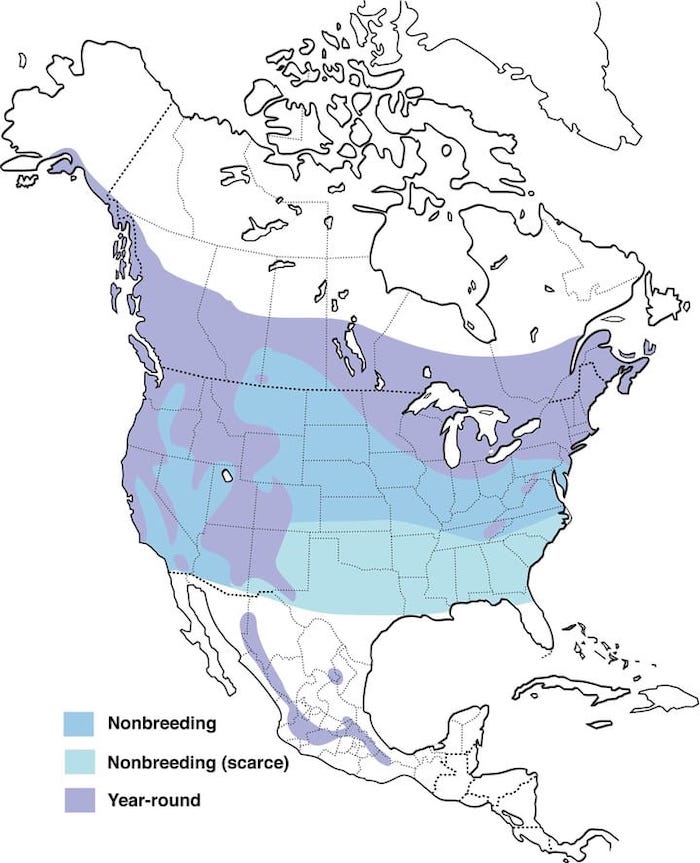
Saw-whets span North America coast to coast. Our locals appear to migrate along the west coast, but they freely travel east-west, too. They nest in our forests and parts north, well into Canada, where they are apt to retreat if American forests continue to suffer as expected from climate disruption.
As for their name, it is another of their mysteries. It supposedly recognizes a similarity in the sound of saw-sharpening and the owl’s vocalization, but that match eludes most of us.
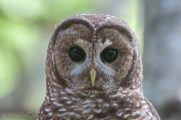
The spotted owl, to itself no more upsetting than a robin, has become a focal point of human controversy in the Pacific Northwest. Stephanie Houtman, Environmental Planner/Biologist for Caltrans, will present an in-depth history and natural history of Northern Spotted Owls. Her discussion will include the owl’s decline and the impacts of forestry, regulation, the barred owl invasion, and fire. This is an opportunity to learn of this substantial interface of conflicting demands and conditions in our back yard.