
Tag Archives | Zoom

Habitat Gardening in Fire Prone Landscapes

By: Adrienne Edwards & Rachel Schleiger

Destructive wildfires are becoming larger, hotter, and more frequent. Since 2000, an average of 7.1 million acres have burned across the US, more than double the average acreage that burned in the 1990s. In 2020, wildfires burned 10.3 million acres in the US, and roughly 60% was in California (> 4 million acres), Oregon (> 1 million acres), and Washington (> 700,000 acres). At the same time, more people are choosing to live adjacent to fire-prone wildlands. In California alone, at least 25% of our 11 million residents live in the Wildland / Urban Interface (WUI), where development meets or intermingles with undeveloped. One consequence of this development is an accelerating loss of native biodiversity through habitat fragmentation. The home hardening and defensible spaces that we need to create to live safely near wildlands can also lead to habitat fragmentation.

We can compensate for clearing and building in the WUI by including native plants and wildlife resources in our landscaping. Native plants and wildlife habitat in the human “built environment” effectively create wildlife bridges, or oases, to support pollinators and many of the species they interact with. In this talk, we will first briefly review home hardening and defensive space essentials for wildfire safety. In the remainder of our time we will explore characteristics, installation, and maintenance of native plants (keeping fire safety/readiness in mind) to mitigate for the negative impacts of habitat fragmentation. The wildfires we have been experiencing are traumatic; but we can use lessons learned to help communities become more wildfire ready and resilient, while supporting the native wildland habitats that we love.

Adrienne Edwards, PhD, is a botanist, plant ecologist, garden designer, and environmental consultant. She began her botanical odyssey in the Southeast, spent time botanizing in the Midwest, and since 2006 has lived and worked in northern California. With over 30 years of experience teaching, researching, and consulting, plants continue to inspire her passion. She is currently a faculty lecturer at California State University, Chico.

Rachel Schleiger, MS, is a plant ecologist who specializes in restoration ecology. She has lived in the Sierra Nevada Foothills most of her life. Her family and property survived the most deadly and destructive Western fire on record, the 2018 Camp Fire. Over the last 3 years, she has developed curriculum to teach about wildfire, both in-person and online through Butte College. She is currently a faculty lecturer at both Butte College and California State University, Chico.

0

Characterizing Barred Owl Dispersal at the Leading Edge of Their Range Expansion

The range expansion of the Barred Owl (Strix varia) into western North America over the last century has emerged as a major threat to the Northern Spotted Owl (S. occidentalis caurina) and likely to the health of western forest ecosystems more broadly. A better understanding of Barred Owl natal dispersal, one of the primary driving mechanisms of range expansion, is needed for the implementation of effective management. Whitney led a team of researchers in the attachment of satellite-GPS tags to juvenile Barred Owls in the Coastal Redwood Region of northern California in order to characterize their movement, survival, and habitat selection as they disperse from natal territories. These tags allow for fully remote tracking of owls and have the potential to provide locations of owls up to 1.5 years past the date of deployment. She has been following the movements of 31 juvenile Barred Owls tagged during the summers of 2020 and 2021, and will discuss preliminary findings regarding their survival rates, dispersal distances, and habitat use during dispersal. Whitney Watson is a master’s student in the Department of Forest and Wildlife Ecology at University of Wisconsin – Madison studying the spatial ecology and bioacoustic detectability of Barred Owls in the western U.S. She grew up in Minneapolis, MN and received a B.A. in Biology from Macalester College in Saint Paul, MN, where she developed an interest in wildlife ecology while conducting research on tent-roosting bats in Costa Rica. She worked in forestry and wildlife management in the Midwest and contributed to research on various ecological systems across the U.S. before becoming involved with Spotted Owl and Barred Owl research on the West Coast.

Here is the link to register: http://www.mendocinocoastaudubon.org

0

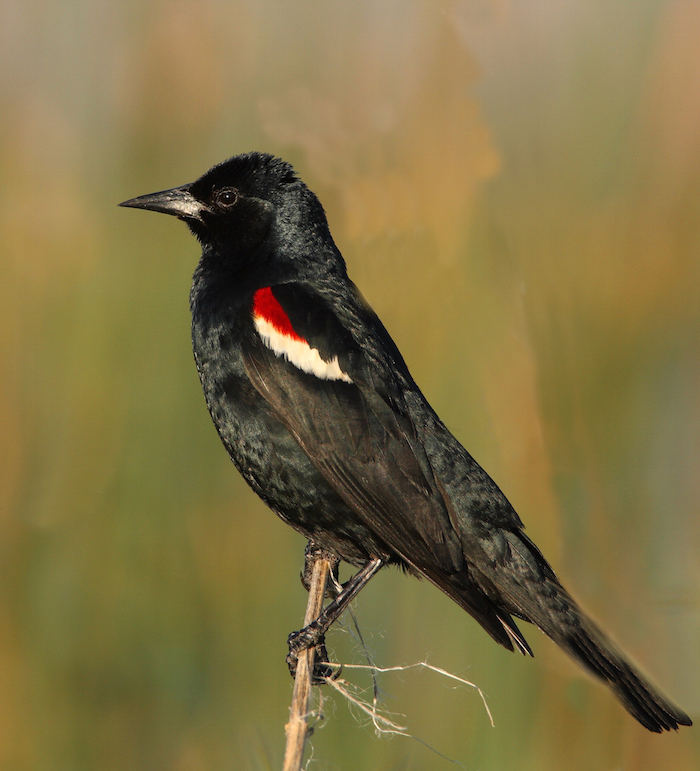
Protecting Tricolor Blackbird Colonies

Tricolored Blackbird by David Bogener

Tricolored Blackbird by David Bogener

Xeronimo Castañeda is a Conservation Project Manager with Audubon California. His work with Audubon focuses on habitat restoration. enhancement, and multi-benefit management of Central Valley wetlands, agricultural operations, and groundwater recharge projects to benefit birds and people. Of special interest to Xeronimo is the tricolored blackbird.

In 1990 the Department of Fish and Game of California, based on significant decline in tricolored blackbird population numbers documented (DFG/ CDW) in the 1980s, added it to the published list of “Bird Species of Special Concern”. At this time the tricolored was added to the U.S. Fish and Wildlife Service (USFWS) list of Birds of Conservation Concern.

Current projects Xeronimo helps lead at Audubon are:

  1. protecting at-risk Tricolored Blackbird colonies,
  2. developing multi-benefit groundwater recharge projects in target regions to benefit birds and communities,
  3. coordinating spring flooding of private wetlands to support migratory shorebirds, and
  4. on-farm habitat enhancement using cover crops and through riparian restoration.

A native of California Xeronimo has lived and worked from Monterey to Arcata eventually finding his way to Sacramento. Away from work, Xeronimo spends time backpacking, riding bikes, cooking, and of course birding.

Topic: Saving Tricolored Blackbirds
Time: Oct 13, 2021 07:00 PM Pacific Time (US and Canada)

Join Zoom Meeting
https://us06web.zoom.us/j/88112829846

Meeting ID: 881 1282 9846
One tap mobile
+16699006833,,88112829846# US (San Jose)
+12532158782,,88112829846# US (Tacoma)

Dial by your location
+1 669 900 6833 US (San Jose)
+1 253 215 8782 US (Tacoma)
+1 346 248 7799 US (Houston)
+1 301 715 8592 US (Washington DC)
+1 312 626 6799 US (Chicago)
+1 929 205 6099 US (New York)
Meeting ID: 881 1282 9846
Find your local number: https://us06web.zoom.us/u/kcLlDkbcyg
When you login to our Zoom meetings you will be placed into a waiting room until the meeting begins. Participants are muted upon entry but are welcome to unmute themselves before the meeting begins. Once the presentation begins, you can raise your hand to ask questions or type a question into chat. A moderator will control the order of your questions.

All of our presentations will be posted on our YouTube page where you can also find several bird videos. We are also posting Zoom presentations from several other organizations on our calendar page – including Altacal Audubon, Redbud Audubon, Redwood Region Audubon, Mendocino Coast Audubon, Peregrine Audubon, Plumas Audubon and Golden Gate Audubon.


0

The Art of the Bird

The human history of depicting birds dates to as many as 40,000 years ago, when Paleolithic artists took to cave walls to capture winged and other beasts. But the art form has reached its peak in the last four hundred years. Carol and Roger will discuss how art has impacted ornithology since the 17th century and how advances in ornithology have changed the way artists have depicted birds. Carol will also spend a bit of time in her studio talking about how she has illustrated the Birds of Bidwell Park, Trees of Bidwell Park, and our upcoming Wildflowers of Bidwell Park.

Dr. Carol Burr is Professor Emeritus of English at California State University, Chico, where she taught literature classes, created the Honors Program, served as English Department Chair, and directed the Center for Multicultural and Gender Studies. She edited and published Unstill Lives: Women of Northern California and Feeling for Place and coauthored Latin for Bird Lovers. She is also an artist and has worked in oil, watercolor, and charcoal. She drew the illustrations for Birds of Bidwell Park and The Trees of Bidwell Park using pen, pencil, and watercolor. She is involved in many local organizations such as the League of Women Voters, Soroptimist International, the Discovery Shop thrift store, and is the longest serving member (over 20 years) of Bidwell Park’s Ambassador’s program.

Join Zoom Meeting

https://us02web.zoom.us/j/81369174103?pwd=MFlQa2xTZFZ1L0dlUEU2ck9yb2g2QT09

Meeting ID: 813 6917

0

No Birdbrains Here: The Latest on Bird Learning, Instinct, and Intelligence

Birds can learn from consequences, as we and many other species can:  Baby chicks learn to peck accurately, wild mockingbirds learn to recognize individual people, and pigeons learned to categorize art and music.  Even instinctive behaviors like imprinting can be more flexible than scientists used to think, and songbird song appears particularly malleable.  This talk will explore bird learning and intelligence, from everyday foraging, to learning through observing, to tool use.  Such adaptability may be critical as wild birds attempt to adjust to the many threats they face.  Scientists also take advantage of this powerful learning ability to help save endangered species.

About Our Speaker:
A behavioral and biopsychologist, Dr. Susan Schneider is an expert on learning principles and nature-nurture relations. She’s also an avid birder, field trip leader, and environmental activist. A Past President of San Joaquin Audubon, she is currently focused on applying learning principles to the climate crisis.  Her award-winning book for the public, The Science of Consequences: How They Affect Genes, Change the Brain, and Impact our World, was a selection of the Scientific American Book Club.  Schneider is a Visiting Scholar at University of the Pacific (Stockton) and a consultant for the Bay- area sustainability nonprofit Root Solutions. The website for her book is: http://www.scienceofconsequences.com

Kern Audubon Society is inviting you to a scheduled Zoom meeting.

Topic: Kern Audubon Society’s May Zoom Meeting
Time: May 4, 2021 07:00 PM Pacific Time (US and Canada)
Join Zoom Meeting

https://zoom.us/j/96014561861?pwd=N0JiL1plZDZaV09FQVJvOTl2TFArdz09

Meeting ID: 960 1456 1861
Passcode: 597717
One tap mobile
+16699009128,,96014561861#,,,,*597717# US (San Jose)
+13462487799,,96014561861#,,,,*597717# US (Houston)
Dial by your location
+1 669 900 9128 US (San Jose)
+1 346 248 7799 US (Houston)
+1 253 215 8782 US (Tacoma)
+1 312 626 6799 US (Chicago)
+1 646 558 8656 US (New York)
+1 301 715 8592 US (Washington DC)
Meeting ID: 960 1456 1861
Passcode: 597717
Find your local number: https://zoom.us/u/abJY8T5NYX

0